Twelve Good Posts a Year
Everyone tells small businesses to post daily. Twenty-one posts and then eleven months of silence is worse than twelve good ones — here's how to pick a cadence you'll still be keeping next year.
Everyone tells small businesses to post every day.
So you try. Five days, then a week gets away from you, then it’s been a fortnight and posting again feels like walking back into a room you left in a hurry. Six months later the account has eleven posts on it, all from the same March.
That’s not a discipline problem. The advice was written for people whose actual job is posting.
Do the maths on what actually happened
The daily attempt: twenty-one posts in three weeks, then nothing for eleven months.
One good post a month: twelve posts. That’s it. Twelve.
Fewer posts, better year — because the second business was visible in November, when a customer went looking. Twelve isn’t an impressive number. It’s a number that survives contact with a real year.
An abandoned account is worse than a quiet one
This is the part that doesn’t get said, and it’s the strongest argument for starting small.
People check your socials to find out whether you still exist. Not to be entertained — to check you’re still trading, still doing that thing, still worth ringing. A page with twelve posts and one from a fortnight ago says the business is running. Sixty posts and nothing since last winter says something else.
So daily-then-nothing doesn’t just waste the effort. It leaves behind proof that you gave up.
Pick the number you can do in your worst month
This is the technique, and it’s the opposite of how most people choose.
Don’t pick a cadence from a good week — the week you’re motivated and the shop’s quiet. Pick what you could still manage in your worst month. The flu, the staff member who quit, the busiest fortnight of your year.
Whatever you could do in that month is your real cadence. For a lot of small businesses that’s monthly. Almost nobody’s honest answer is daily, and that’s fine. Everything above your number is a bonus, not a target.
Then ratchet, slowly. Three months at once a month without it feeling like a chore, then go to twice. Most small businesses should stop at weekly and never go past it.
Kill the streak
“Don’t break the chain” is actively harmful here. A streak makes missing one post feel like losing something, and the natural response to losing a streak is to stop altogether — which is the exact failure we’re avoiding.
So there is no streak. Miss the first Tuesday and the next one is the first Tuesday of next month. Nothing is owed: no catch-up post, and definitely no apology post. Nobody noticed, and mentioning it only points at the gap.
Missing one is a Tuesday. It isn’t a verdict.
Put a date on it — then put something in it
“Monthly” doesn’t happen. “First Tuesday” happens. A frequency is a wish; a date is an appointment.
But the appointment fails for a reason that isn’t forgetting. The reminder goes off, you open the app, and you’ve got nothing — so you close it again. The date wasn’t the weak part. Turning up to it empty was.
So the technique has a second half: keep the next three slots filled. Not written — filled. A line each is enough. “The thing about safety switches and rain.” “Photo of the 5am prep.” “Answer that question about gluten-free bases.”
Three, because three survives a bad month: skip one and you’ve still got two in hand, so the gap costs you a slot instead of the habit.
What it really changes is the size of the ask. A reminder meaning think of something, write it, post it is three jobs starting at 9pm. A reminder meaning post the thing you already decided is one small one. Same appointment, completely different weight.
What “good” has to mean at twelve a year
At this volume each post carries more weight. Not more polish — more substance. One of three things:
- Useful. It helps someone avoid a problem or make a decision.
- Specific. It contains a real number, name or place.
- Human. A person, doing something, described honestly.
What it can’t be is an announcement. If you get twelve shots a year, don’t spend one on your opening hours.
“Doesn’t the algorithm reward posting more?”
A bit. But only if you sustain it — and the algorithm’s memory of your three good weeks in March is short, while your customers’ memory of a dead page is long. For most local businesses, reach isn’t the binding constraint. Being invisible for eleven months is.
Do this tonight
- Count your actual posts over the last twelve months. That’s your real rate, not what you intended.
- Decide what you could manage in your worst month.
- Pick a specific day — first Tuesday, last Friday, whatever.
- Write one line each for the next three. Enough that you’d know what you meant in a fortnight.
- Do it three times before you consider increasing.
Twelve good ones. That’s a real year of marketing, and it starts next Tuesday.
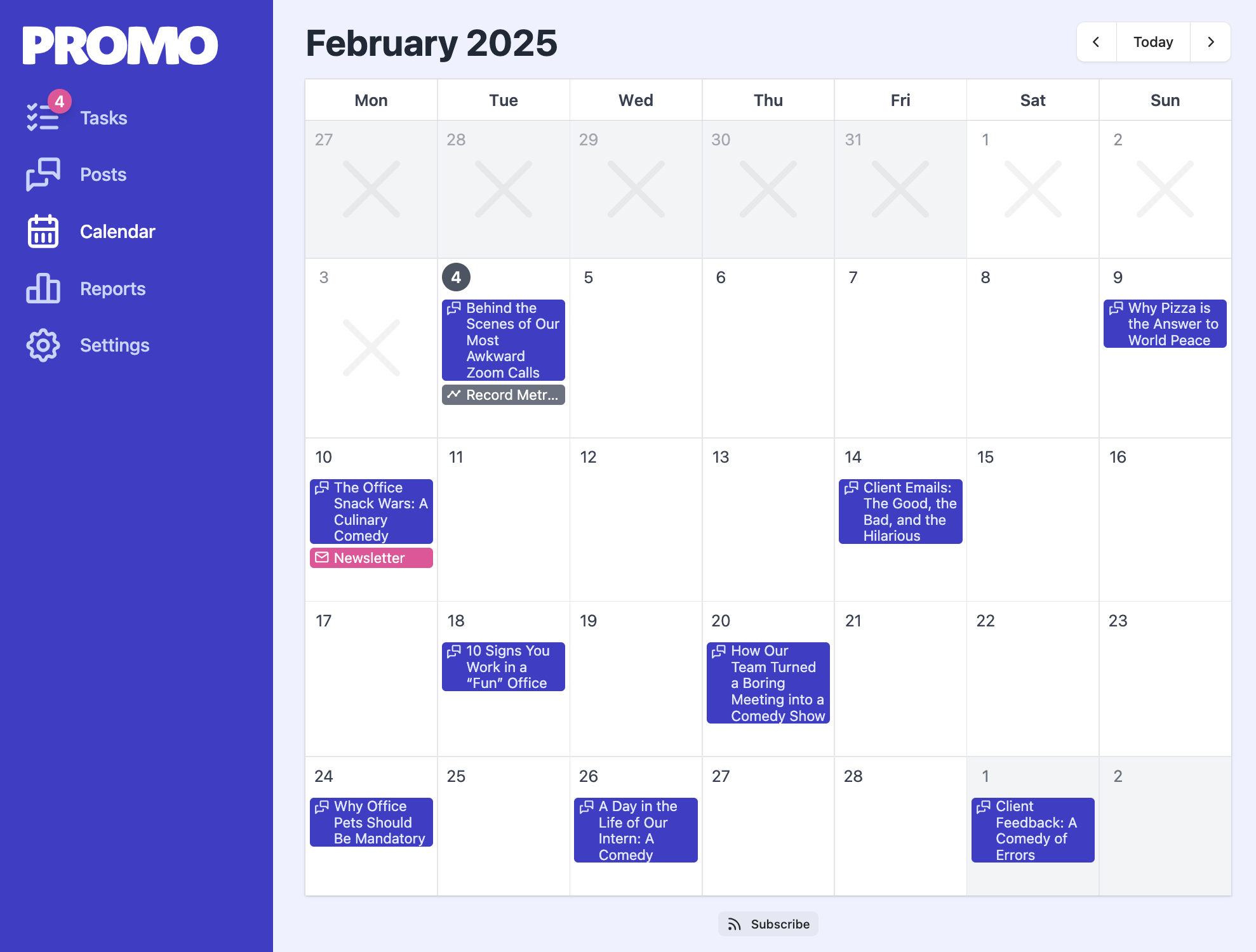
Promo is built around this: you drag the next few posts onto a calendar and it reminds you when one’s due, so the plan and the prompt live in the same place. A note on the fridge and a recurring alarm do the same two jobs for nothing, and if that’s all you take from this, take it.