You Don't Need Different Content for Every Platform
Instagram wants something visual, LinkedIn something professional, and the newsletter is a whole separate job. It isn't. One idea, three small edits, and the newsletter writes itself.
Somewhere along the way, small businesses got told that every platform needs its own content.
Instagram wants something visual. LinkedIn wants something professional. Facebook wants something else again. X wants it short. And then the newsletter is a whole separate project, so that never happens either.
Which turns “post something this week” into five writing jobs and an email. So you do none of them.
The advice isn’t wrong, exactly. It’s just written for people with staff. If your job title is Social Media Manager, tailoring content per platform is a good use of your Tuesday. If you run a physio clinic, it’s the reason your Instagram hasn’t been touched since March.
Here’s the version for people with a business to run.
The idea travels. The packaging changes.
The thing that takes the effort — the idea, the opinion, the story, the actual useful bit — works everywhere. Nobody’s brain switches over between apps. A good point about why safety switches trip when it rains is a good point on Facebook, on LinkedIn, in a newsletter, and said out loud to a customer.
What changes between platforms is small, mechanical, and takes about ninety seconds:
1. Length. Trim or expand. Same words, fewer of them. 2. The first line. Some platforms cut you off after one line, so the hook has to move to the front. 3. The ask. Where the link goes, or whether a link works at all.
That’s the list. Three edits, not five drafts.
What actually differs, concretely
| Length | First line | The ask | |
|---|---|---|---|
| Longer is fine. Warmest tone. | Less critical — a couple of lines show | Link works in the post. Fine to just include it. | |
| Medium. 80–150 words. | Critical — it truncates fast, so the hook goes first | Links in the body get less reach. Put it in the first comment. | |
| Short caption, front-loaded | Critical — captions collapse | Links don’t work in captions. “Link in bio”, or ask them to message you. | |
| X | Tightest version. Cut to the claim. | It’s all first line | One link, at the end of a thread rather than in every post. |
| Newsletter | The full version, plus two sentences of context | Subject line does this job | Link works normally. |
Notice that none of those columns require a different idea. You write the thing once, in its fullest form, then cut it down four times. Cutting is much faster than writing.
The newsletter is not a separate project
This is where most of the wasted effort sits.
People treat the newsletter as another content job — a thing that needs its own ideas, written fresh, on top of everything else. So it gets skipped, or it gets sent twice and abandoned.
Your newsletter is a container for what you already said. Take the month’s posts, put them in an email with a sentence of connective tissue, add a line at the top about how the month went, send it.
That’s not cutting corners. It’s the correct way round. Most of the people on your email list didn’t see most of your posts — organic reach on any single post is a fraction of your following. Which means the newsletter isn’t a repeat, it’s the first time most of those people encounter it.
You’re not writing it twice. You’re delivering it to the people who missed it.
Beware “repurposing” that’s actually more work
There’s a whole genre of advice that sounds like leverage and isn’t. Turn your blog post into a carousel, a reel, a thread, a podcast episode, an infographic and a LinkedIn newsletter.
That’s seven pieces of work wearing a hat that says “efficiency.”
Real leverage means doing less, not converting more. One idea, written once, trimmed four times, and then collected into an email at month’s end. If a repurposing tip adds a production step — designing, filming, editing — it isn’t leverage for a business your size, however often you see it recommended.
A decent filter for any marketing advice: does the person giving it have your constraints? If they’ve got a designer and a video editor, their workflow isn’t available to you, and copying the shape of it without the staff just produces a half-finished version of their week.
Two things people worry about, and shouldn’t
“Won’t people notice it’s the same post?”
Almost nobody follows a small business on more than one platform. Of the handful who do, the ones who notice are your most engaged customers, and they don’t mind — they mind about your business, which is why they followed you twice.
The exception is obvious cross-posting artefacts: a tweet auto-posted to LinkedIn with three hashtags and an @handle that means nothing there, or a Facebook post that says “link in bio” when the link would have worked fine in the post. That’s not the same content offending people, that’s the seams showing. The three edits above fix all of it.
“Isn’t posting the same thing again lazy?”
Reposting a good thing three months later is one of the highest-return moves available to a small business, and it’s almost never done. Your audience has turned over, your reach on the original was low, and you’ve probably got a better version of the sentence now.
The bit that also tells you something
Since you’re posting one idea to several places, you’ve accidentally created a clean experiment: same content, same day, different platforms. Any difference in response is the platform, not the post.
Use a different link for each one — most free link shorteners will make you as many as you like — and after a month or two you’ll know which platform actually sends people to your website. Not which one gets the most likes. Which one produces visitors.
That’s usually a surprise, and it’s the single most useful thing you can learn about your own marketing. It’s also the thing that lets you cut a platform without guessing. More on that in Four Numbers Worth Tracking Every Month.
The whole workflow
- Write one good thing. Its fullest version. Take your time — this is where the effort belongs.
- Trim it four times. Adjust length, move the hook to the front, fix the ask.
- Give each platform its own link.
- Post it. Natively, on each one.
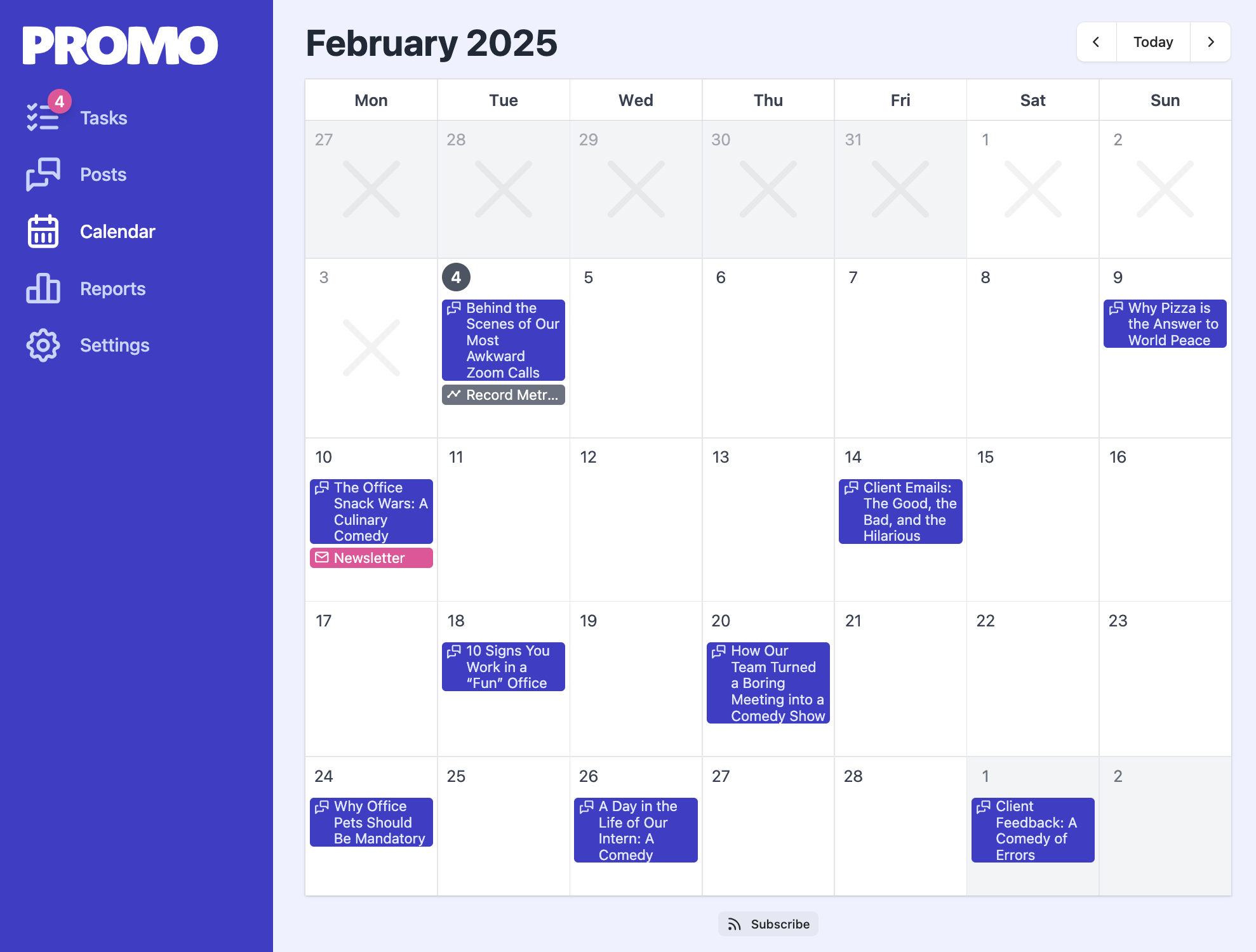
- At the end of the month, collect what you posted into an email with a line of context, and send it.
One idea. Five or six appearances. About twenty minutes of extra work after the writing is done — and the writing was going to happen anyway.
That’s how twelve good posts a year turns into a genuine year of marketing instead of twelve quiet Tuesdays.
Promo does step 3 for you and builds step 5 out of whatever you posted — but the whole workflow runs fine on a free link shortener and a folder of drafts, and if that’s where you start, good.